Almost everyone has signed something they did not fully read. A phone plan, a gym membership, a quote from a tradie, a lease, a sale contract, an employment agreement. Most of the time nothing goes wrong. But when something does, the first thing anyone reaches for is the contract, and the clauses nobody paid attention to suddenly become the only thing that matters.
The good news is that you do not need a law degree to spot most of the problems. A contract is a set of promises, and a handful of clauses do most of the heavy lifting. If you know what they are, what they are supposed to do and how they can be used against you, you can read a document with far more confidence, and you will know when it is time to ask for help.
This guide is written for individuals and small business owners in Western Australia who are about to sign an agreement. It covers the key clauses to check before signing across most contracts, the extra points to look for in leases, sale contracts, service agreements and employment contracts, how the unfair contract terms rules may help you, and how to prepare so a lawyer’s time is spent well.
Why Contracts Deserve a Slower Read Than You Think
A contract is a legally binding agreement. As a general rule, once you sign, the courts will expect you to honour it, even if you did not read it, did not understand it or later wish you had negotiated something different. The contract article on Wikipedia gives a helpful overview of how contracts are formed and what they contain, but the practical point is simple: your signature is evidence that you agreed.
Three realities make the fine print worth your time.
- Contracts are drafted by the party who wrote them. The wording usually favours the author, even when it looks neutral.
- The costs of getting out are higher than the costs of getting it right. Renegotiating before you sign is easy. Doing it afterwards, when the other side holds the upper hand, is not.
- Problems tend to appear when things go wrong. A clause you ignore at the start can decide who pays when a job is delayed, a tenant leaves or a supplier does not deliver.
None of this is meant to make you suspicious of every agreement. Most are fair. The aim is to read with purpose.
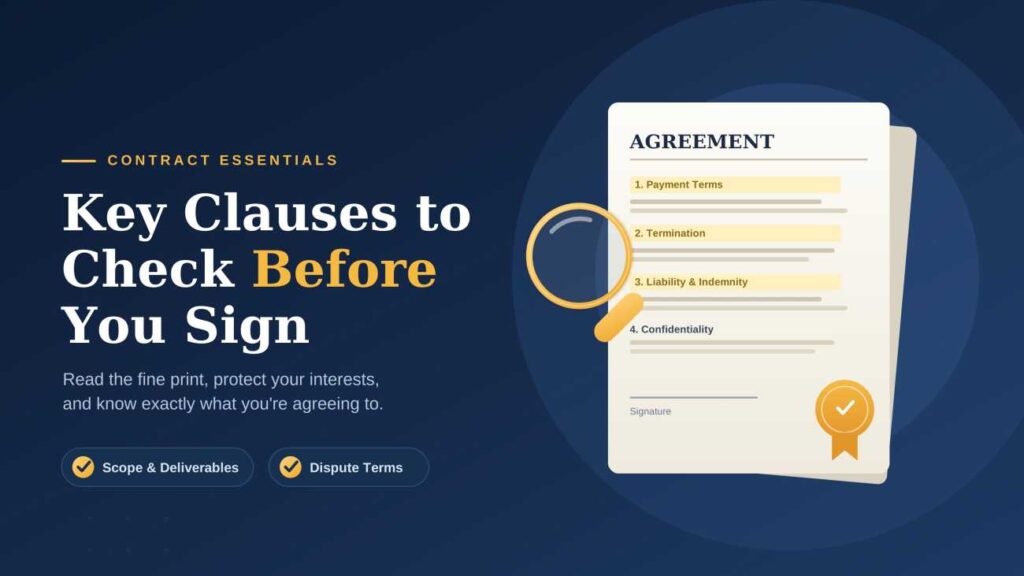
The Key Clauses to Check Before Signing Any Contract
Different agreements have different details, but the same clauses tend to carry the most weight. Work through these in order.
1. Who the Parties Are
It sounds obvious, but get it right. Is the contract with you personally, or your company or trust? Is the other party the entity you thought you were dealing with, or a related company with fewer assets? Check names, ABNs and ACNs, and make sure the party who will perform the obligations is the one who has signed.
2. What Is Actually Being Promised
Look at the scope: the goods, services, premises or work that will be provided. Is it specific? Vague descriptions such as “reasonable endeavours” or “to a high standard” can be hard to enforce. If something was discussed verbally, make sure it appears in the document. Many contracts include an “entire agreement” clause that says only the written terms count.
3. Price, Payment and Extra Costs
Check the price, what it includes, when payment is due and what happens if it is late. Look for:
- Deposits and whether they are refundable
- Progress payments or milestones
- Interest on late payments
- Fees, charges and surcharges that may be added later
- Price variation or escalation clauses
- GST, and whether prices are shown inclusive or exclusive
If you cannot calculate the total you will pay from the document, ask for clarification before you sign.
4. Term, Renewal and Automatic Rollover
How long does the contract last, and what happens at the end? Some agreements renew automatically unless you give notice within a narrow window. Missing it can lock you in for another year or longer. Note the notice dates in your diary the day you sign.
5. Termination: Who Can Leave and When
This is one of the most important clauses. Look at:
- Your right to end the contract. Can you terminate early? On what grounds, with how much notice and at what cost?
- The other party’s right to end it. Is it broader than yours? Can they terminate for convenience while you cannot?
- Consequences. Are there exit fees, repayment of discounts, loss of deposits or ongoing liability?
- Remedy periods. If there is a breach, do you get a fair time to fix it?
A one-sided termination right is a classic red flag.
6. Variation: Can They Change the Deal?
Some contracts allow one party to change prices, terms or services by giving notice. Others require both parties to agree in writing. Be wary of clauses that let the other side change the contract unilaterally, especially if you have no right to walk away without penalty.
7. Liability, Limitations and Exclusions
These clauses set out who pays when something goes wrong. Look for:
- Exclusions of liability. Terms stating the other party is not responsible for certain losses.
- Caps on liability. A limit on how much can be claimed, such as the fees paid.
- Consequential loss exclusions. These can remove your right to claim for lost profits.
- Whether limits apply equally. A cap that protects them but not you should prompt questions.
Some rights under consumer law cannot be excluded by contract, but that does not make these clauses harmless, and they can still shape what is practical to claim.
8. Indemnities
An indemnity is a promise to compensate the other party for certain losses. Broad indemnities can make you responsible for costs you did not cause. Check what is covered, whether it extends to the other party’s own negligence and whether there is any cap.
9. Warranties and Guarantees
What does each party promise about quality, ownership, condition or compliance? Make sure the promises you are relying on appear in writing. Also check what happens if a warranty is untrue. Does the contract specify a remedy?
10. Guarantees and Security
If you are asked to give a personal guarantee, you may be agreeing to pay the company’s debts from your own pocket. Check the amount, the duration, whether it continues after you leave the business and whether it is limited. Also look for charges over assets or caveats over property, which may be buried in the security provisions.
11. Default, Penalties and Interest
What counts as a default, and what are the consequences? Look for default interest rates, administration fees and acceleration clauses that make the whole balance due immediately. Clauses requiring large payments on breach may be challenged if they are out of proportion to the actual loss, but you should not rely on that. Avoid them where you can.
12. Dispute Resolution and Governing Law
How will disputes be handled? Some contracts require mediation or negotiation first. Others specify arbitration, or a court in a particular state. A clause requiring disputes to be resolved far away can make a claim impractical. Check that the governing law and jurisdiction make sense for you.
13. Assignment and Subcontracting
Can the other party transfer the contract to someone else, or hand the work to a subcontractor? Can you? This matters if you plan to sell your business, or if the identity of the service provider is important.
14. Notices and Communication
Contracts often specify how notices must be given, such as by post to a particular address or by email. If you miss a notice because it was sent somewhere you do not check, you may still be bound. Make sure the details are correct and keep them up to date.
15. Boilerplate That Is Not Always Boring
Clauses such as entire agreement, severability, waiver and force majeure appear in most contracts. They are often standard, but not always. A force majeure clause, for example, can excuse one party from performing in certain events, and you should know whether it applies to you.
Extra Points for Common Types of Agreement
Commercial and Retail Leases
Leases are long, expensive and heavy on detail. Beyond the clauses above, check rent and how it is reviewed, outgoings and how they are calculated, the term and options to renew, permitted use, repairs and maintenance, make good obligations at the end, assignment rights, security deposits or bank guarantees, and any guarantee given by directors. Retail shop leases in WA may also be subject to specific legislation, which can add protections, so confirm whether it applies.
Contracts for the Sale or Purchase of Property
Many property contracts rely on standard forms plus special conditions, and the special conditions are where the real negotiation sits. Look carefully at finance conditions and their deadlines, due diligence or inspection conditions, the deposit and when it is released, the settlement date and what happens if it is missed, inclusions and exclusions, easements and encumbrances, and any conditions about vacant possession. Deadlines in property contracts are often strict, and missing one can put the deal or your deposit at risk.
Service and Supply Agreements
For agreements with suppliers, contractors or clients, pay close attention to the scope of work, timeframes and what counts as delay, payment terms, ownership of intellectual property, confidentiality, performance standards, and what happens if the relationship ends. If the contract is a standard form that you have no ability to negotiate, check the unfair terms section below.
Employment Contracts
Look at the position and duties, remuneration and how it is calculated, hours and overtime, probation, leave, notice of termination, bonus and commission terms, confidentiality, intellectual property and any restraint of trade or non-compete clauses. A restraint that is too broad may not be enforceable, but it can still cause trouble before it is tested, so it is worth getting advice on it before you sign.
Franchise and Business Sale Agreements
These can involve large amounts of money and complex obligations. Check what is being sold, warranties about financial performance, restraints on the seller, handover and training, lease assignment and the consequences of a dispute. Independent legal and accounting advice is especially valuable here.
Unfair Contract Terms: A Safety Net for Some Agreements
Since 9 November 2023, changes to the Australian Consumer Law have prohibited businesses from proposing, using or relying on unfair terms in standard form contracts with consumers and small businesses. The Small Business Development Corporation explains that this covers standard form contracts for the supply of goods or services, or the sale or grant of an interest in land, and applies to new or varied contracts from that date.
A standard form contract is generally one prepared by one party and used repeatedly, with the other party having little or no chance to negotiate. Whether a term is unfair depends on its wording and how it operates, looking at the contract as a whole. Examples include terms that let only one party terminate, vary or renew the contract, that exclude or cap liability for one side only, or that limit rights under consumer guarantees. Only a court or tribunal can decide whether a term is actually unfair, and the thresholds for who counts as a small business matter, so these rules are a helpful backstop, not a substitute for reading the contract.
The sensible approach is to try to negotiate unfair terms out before you sign, and to get advice if the other side refuses.
How to Read a Contract Without Getting Lost
A few habits make a long document manageable.
- Start with the summary or schedule. Key details such as price, term and dates are often listed at the front.
- Read the definitions. Words like “services”, “business day” or “default” may be defined in a way that surprises you.
- Follow cross references. A clause may refer to another that changes its meaning.
- Highlight anything you do not understand. Write questions in the margin.
- Read the attachments. Schedules, policies and terms incorporated by reference form part of the deal.
- Check the dates. Note every deadline, notice period and renewal date.
- Do the maths. Calculate the total cost over the full term.
- Imagine the worst case. Ask what happens if it goes wrong, and who bears the risk.
Warning Signs That Call for Caution
- Pressure to sign quickly. Genuine deals can usually wait a day or two for review.
- Verbal promises that are not in writing. If it matters, it should be in the document.
- Blank spaces or missing schedules. Never sign an incomplete contract.
- A refusal to let you take it away. A fair counterparty will allow time.
- Terms that only work in one direction. Obligations should be reasonably balanced.
- Large personal exposure. Guarantees, indemnities and security deserve extra care.
- Lengthy automatic renewals. Make sure you can exit.
- Reassurances that “everyone signs it”. That is not the same as it being fair.
When to Get a Lawyer Involved
You do not need a lawyer for every agreement, but advice is wise when:
- The amount of money involved is significant
- The contract is long, complex or unusual
- You are being asked for a personal guarantee or security
- It is a lease, sale contract, franchise or business purchase
- You are bound for a long period or have limited exit rights
- The other party has dictated the terms and refuses to negotiate
- Your livelihood or home depends on it
- You are unsure what a clause means
The best time to ask is before you sign. A lawyer, such as one of the commercial lawyers in Perth, can explain the document in plain language, point out risks, suggest changes and, where appropriate, negotiate on your behalf. Advice before signing is usually far cheaper than resolving a dispute afterwards.
How to Prepare for the Meeting
To get the most from a first consultation, which you can request through the contact page, come prepared:
- Bring the full contract, including attachments and any correspondence.
- Explain the deal and what you expect from it in plain terms.
- Note deadlines for signing, conditions and settlement.
- List your concerns and the clauses you do not understand.
- Share your priorities, such as flexibility, price or certainty.
- Ask for a fee estimate and what is included.
Final Word
A few well-chosen questions before you sign can protect your home, your business and your peace of mind. Check who is bound, what is promised, how much it costs, how you can leave, who bears the risk and how disputes are resolved. If the document is important, long or one sided, get independent advice while there is still time to change it. For more plain-English guides, browse the law articles and resources.
If you live in or near Armadale and are looking for a lawyer to review a contract before you sign, are you ready to speak with DFG Legal Armadale about your agreement?
Frequently Asked Questions
1. Am I legally bound by a contract I signed without reading?
Generally, yes. Courts usually hold people to the contracts they sign, whether or not they read them. There are limited exceptions, such as where there was misleading conduct, serious unfairness or a term that breaches consumer law, but you should not rely on them. Reading and understanding the document before signing is the safest course.
2. What are unfair contract terms, and do they apply to me?
Unfair contract terms rules in the Australian Consumer Law apply to standard form contracts with consumers and small businesses, and changes from 9 November 2023 strengthened them. Examples include terms that let only one party end or change the contract, or that limit liability for one side only. Whether the rules apply depends on the contract and the size of the business, and only a court or tribunal can decide whether a term is unfair.
3. Can I negotiate a contract that is presented as non-negotiable?
Often, yes. Many terms are negotiable even when they are presented as standard, particularly if you raise specific concerns and propose reasonable changes. A lawyer can help identify which terms are worth pushing on, and which are unlikely to change. If the other side refuses to move on terms that put you at serious risk, that is useful information about whether to proceed.
4. What should I do if I am asked to give a personal guarantee?
Take it seriously. A guarantee can make you personally liable for a company’s debts, sometimes for longer than you expect. Ask whether it can be limited in amount or time, whether the guarantee ends when you leave the business and whether other security could be offered instead. Get legal advice before signing.
5. How long does a lawyer need to review a contract?
It depends on the length and complexity. A short, simple agreement may be reviewed quickly, while a lease, sale contract or business purchase may take longer, particularly if negotiation is needed. Ask for the contract early, tell the lawyer your deadline and avoid leaving the review until the last day.
Sources
- Contract (Wikipedia)
- Unfair contract terms guide (Small Business Development Corporation, Government of Western Australia)
This article is general information only and does not constitute legal advice. Contract law is complex and applies differently depending on the facts and the document. Always seek advice from a qualified lawyer about your specific agreement before signing.